
If you are asking do you get bail money back after a criminal case ends, the answer depends first on what kind of payment was made. Money paid directly to a court as bail is different from a premium paid to a bail bond company, and both are different from collateral used to secure a bond.
In Delaware, court-posted bail may be returned after the applicable court process is complete. Delaware Courts states that bail is returned to the individual who posted it once the defendant's trial has concluded, while forfeiture, court orders, applicable financial obligations, or other circumstances can affect how funds are handled. This guide explains those differences in plain English so families can identify what they paid and what to do next.
Quick Answer
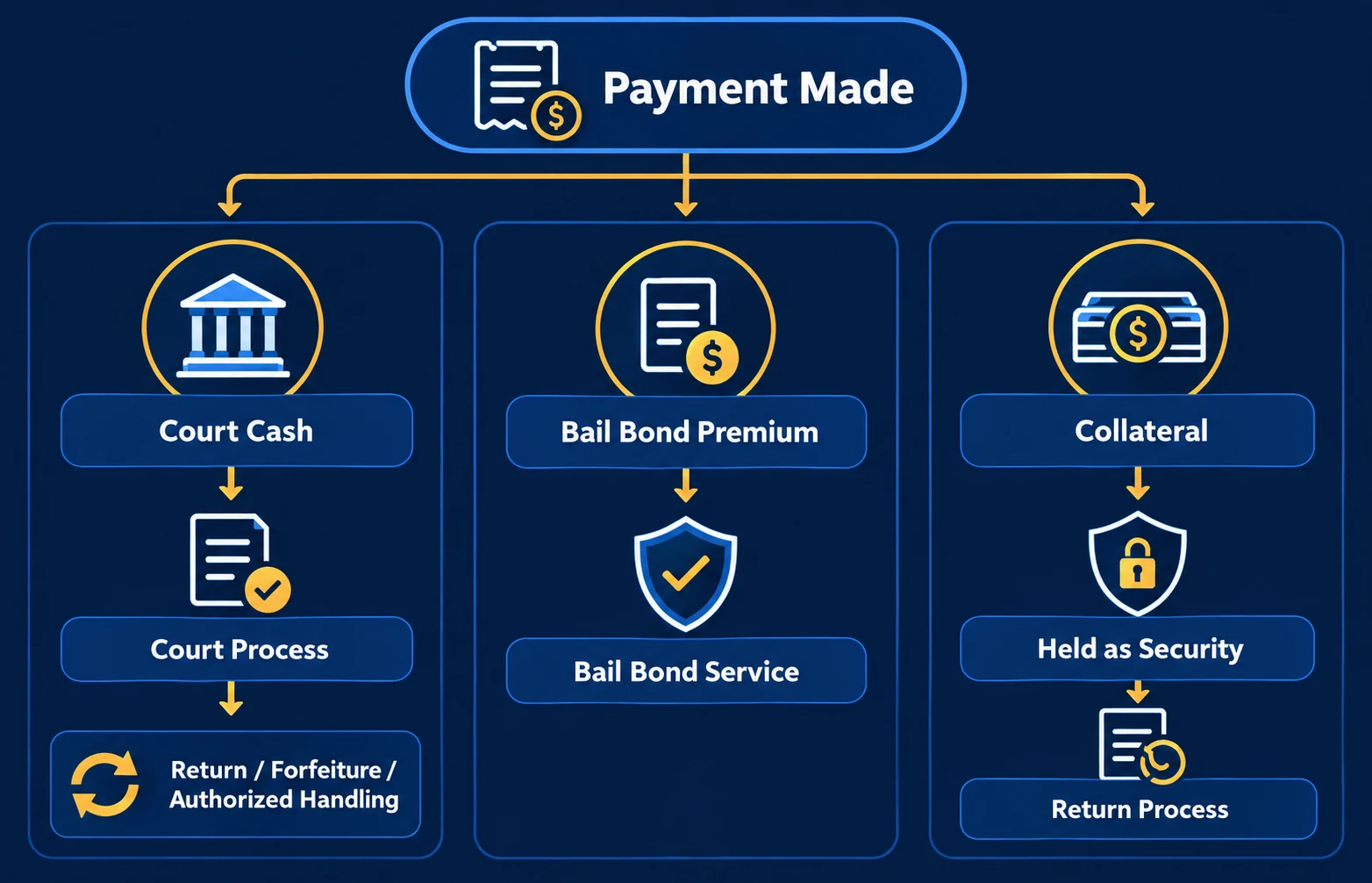
So, do you get bail money back? Sometimes, but the answer starts with identifying what kind of payment was made. Cash posted directly with a Delaware court, a bail bond premium, and collateral are three different types of payments.
| Payment type | Usually paid to | What happens later? |
|---|---|---|
| Cash bail | Delaware court | May be returned after the required court process, subject to forfeiture, court orders, or applicable financial obligations. |
| Bail bond premium | Bail agent | Payment for the bail bond service; separate from a court cash-bail refund. |
| Collateral | Bail agent or surety | Separate return requirements apply after the secured obligation and applicable conditions are resolved. |
Start With What You Paid: Court Cash, Bond Premium, or Collateral
Before you can accurately answer do you get bail money back, identify the payment itself. Families often use the words bail money, bond money, fee, and collateral as though they mean the same thing. Legally and financially, they can represent different transactions.
Local bail agent note: Families frequently call several different types of payments bail money. Before asking whether money comes back, first determine whether it was cash paid to the court, a bail bond premium, or collateral.
Cash Paid Directly to a Delaware Court
Delaware Courts describes cash-only bail as a designated amount of money paid to the court by the defendant or someone acting on the defendant's behalf. Secured bail may also involve cash or property posted as security. The purpose of bail is to help ensure that the defendant appears for required court proceedings.
For families asking do you get bail money back, cash paid directly to a court follows a different path from a bail-agent premium. For a fuller definition, read our guide on what a cash bond is in Delaware.
Money Paid for a Bail Bond Service
When a bail agent provides a surety or property bail bond, the amount charged for that service is a premium. Delaware law defines premium as consideration for a surety or property bail bond. A premium should not be confused with cash that a family member personally deposited with the court.
For more detail, see how much a bail bond costs in Delaware and our Delaware bail vs. bond guide.
Property or Other Collateral Used to Secure a Bond
Collateral is a third category. Delaware law defines collateral as money or other property pledged as security or surety for a bail bond in connection with a judicial proceeding. A bond premium and collateral should not be treated as though they have the same return rules.
If your paperwork involves a surety bond, review surety bail bonds in Delaware.
Do You Get Bail Money Back If You Are Found Guilty?
A guilty plea or conviction does not, by itself, mean that court-held bail is automatically forfeited. Relevant questions include whether the defendant complied with appearance requirements, whether the case reached final disposition, whether the court entered an order concerning the bail, and whether other authorized obligations affect the disbursement.
| Case situation | Automatic answer? | What should be checked? |
|---|---|---|
| Charges dismissed | Do not assume an immediate full refund. | Final disposition, bail status, posting party, court orders, and authorized handling. |
| Acquitted | Verdict alone does not answer every refund question. | Bail status, posting party, court record, and applicable orders. |
| Guilty plea or conviction | Do not assume bail was forfeited. | Appearance compliance, final disposition, court orders, and applicable obligations. |
| Failure to appear | Forfeiture may become an issue. | Actual court record and any forfeiture action or order. |
Where Does the Money Stay While the Case Is Pending?
Another common question behind do you get bail money back is where the money is in the meantime. If cash bail was paid directly to a Delaware court, it remains part of the court-controlled bail process until it can be released or otherwise handled under applicable court authority. That is separate from a premium or collateral involved in a private bail bond transaction.
Who Gets the Money Back If a Friend or Relative Paid?
When asking do you get bail money back, families should also ask who actually posted it. Delaware Courts states that bail is returned to the individual who posted it after the trial concludes. Court records and any applicable orders therefore matter when determining who receives an authorized refund.
What Can Reduce, Delay, or Prevent a Bail Refund?
Several issues can change the answer, especially forfeiture, court-authorized handling of funds, case status, or documentation problems. Delaware Courts warns that if a defendant fails to appear as promised, the bail may be forfeited.
- Missing a required court appearance.
- Court-authorized financial obligations or orders affecting the funds.
- Missing receipts, outdated contact details, unresolved case status, or uncertainty about the correct court.
How to Get Bail Money Back in Delaware: A Practical Checklist
- Identify the payment type. Determine whether you posted court cash, paid a premium, or provided collateral.
- Find the payment records. Keep the bail receipt, bond agreement, collateral receipt, case number, and related documents together.
- Confirm the case status. Check whether the case has reached final disposition or whether a court order addresses the bail.
- Identify the court with authority. Confirm which Delaware court should handle the refund question.
- Be prepared to verify the payer. Keep identification and available payment documentation ready.
- Ask the right party about the right payment. Court-held cash questions belong with the appropriate court; premium or collateral questions may belong with the bail agent.
What Happens to Collateral After a Delaware Surety Bond Ends?
Delaware law provides specific protections and duties involving collateral rather than treating it as simply refundable or nonrefundable. Generally, collateral held by a bail agent is returned to the person who deposited it, or that person's authorized recipient, after the secured obligation is discharged and applicable fees owed to the bail agent have been paid.
Three Bail-Money Examples Families Can Use
Example 1: A Parent Pays Cash to the Court
Maria pays cash directly to a Delaware court for her son's bail and keeps the receipt. The better approach is to verify the case and bail status with the appropriate court. Because Maria was the posting party, court records matter when determining who receives an authorized refund.
Example 2: A Family Uses a Bail Bond Company
A family enters into a bail bond agreement and pays a premium. That premium is connected with the bail bond service and should not be described as though the same amount was deposited into a refundable court account.
Example 3: Collateral Is Used With a Surety Bond
A relative provides collateral in connection with a bail bond agreement. Once the obligation it secured is discharged and applicable conditions are satisfied, Delaware's collateral-return requirements become relevant.
| Issue | Best starting point |
|---|---|
| Cash posted directly with a court | Appropriate Delaware court handling the bail matter |
| Premium or bail bond contract question | Bail agent involved in the transaction |
| Collateral return question | Bail agent or surety involved, followed by appropriate regulatory or legal route if necessary |
| Case-specific legal advice | Qualified attorney |
Questions Delaware Families Ask About Bail Refunds
Do You Get Bail Money Back When Charges Are Dropped?
Cash posted with a court may become eligible for return after the case reaches the required disposition, but dismissal alone should not be treated as a promise of an immediate or full refund. The court record, bail status, posting party, applicable orders, and authorized handling of funds still matter.
Do You Get Bond Money Back After the Case Ends?
Bond money can mean different things. Cash personally posted with the court follows court procedures. A bail-agent premium is separate from court-held cash. Collateral is subject to the bond agreement and applicable Delaware requirements.
What Happens If I Lost the Bail Receipt?
A missing receipt does not necessarily mean the money is lost. Contact the appropriate Delaware court and ask what documentation it requires when the original receipt is unavailable.
What Should I Do If My Bail Refund Has Not Arrived?
Confirm the case and bail status, appropriate court, posting-party information, mailing details, and whether any court order or applicable financial obligation affects the funds. For collateral or bail-bond contract issues, contact the relevant bail agent.
How Long Does a Bail Refund Take in Delaware?
Do not rely on a fixed timeline quoted for another state. Processing can depend on case status, the court handling the matter, verification of the posting party, and other circumstances.
Need Help Understanding a Delaware Bail Payment?
Families sometimes know that money was paid but are not sure whether it was cash bail, a premium, or collateral. A Way to Freedom Bail Bonds can help explain the type of bail-bond transaction or payment documentation connected with its services.
Decisions about court-held funds, court orders, refunds, or an individual criminal case remain matters for the appropriate Delaware court or a qualified attorney. You can contact A Way to Freedom Bail Bonds if you need help understanding payment paperwork connected with a Delaware bail bond.
This article provides general educational information about bail payments and refunds in Delaware and is not legal advice. Court procedures, orders, contractual terms, and individual circumstances can affect a specific case.
Conclusion
The simplest way to answer do you get bail money back is to identify what was paid before looking for a refund. Cash deposited directly with a Delaware court, a bail bond premium, and collateral are different types of money with different rules. Court-held bail may be released after the appropriate court process, while forfeiture, financial obligations, or court orders can affect the result; collateral follows separate Delaware requirements. Keep your receipts and agreements, confirm the court and case status, and ask the court, bail agent, or qualified attorney the question that matches the type of payment involved.